
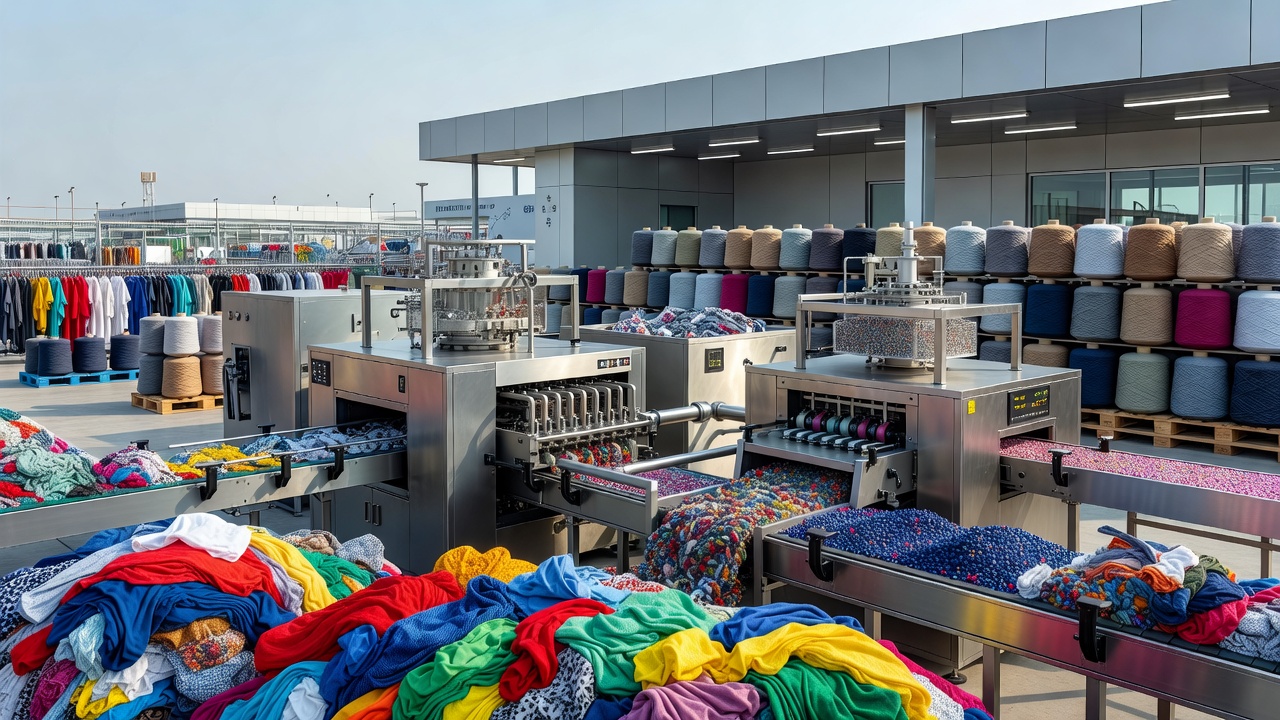
A company in Anhui Province has developed a closed-loop method that recycles colored textile waste directly into recycled polyester yarn, skipping the decolorizing step that conventional chemical recycling requires. According to Science and Technology Daily, the process has reached large-scale production, and the resulting fibers are reported to match virgin polyester in strength and color fastness.
Why pre-bleaching has been a bottleneck
Textile recycling generally follows two routes: physical and chemical. Chemical depolymerision breaks polymer chains back into their building blocks, but it usually needs high-purity feedstock. That means colored garments must first be stripped of their dyes. The extra step raises costs and produces wastewater containing dye residues, which adds an environmental burden of its own.
How the new process works
The company's patented method combines physical and chemical treatments so that dyed waste can be processed without decolorization. According to the report, the process alters the polyester molecular chains and converts dyed material into high-quality recycled fibers within a "textile-to-textile" loop. The developers say this cuts water and energy use, though the supplied reporting does not give specific figures for those savings.
A supply chain built around local industry
The technology was developed under a provincial collaborative innovation project and is being integrated with local industrial clusters, including garment manufacturing and circular-economy businesses. Together they form a chain running from collection and pelletizing through spinning and weaving. Researchers plan to next examine the carbon footprint of the recycled fibers and how they can be functionally modified, but those results are not yet available.
For US readers, the development is a reminder that much discarded clothing is hard to recycle because of its dyes. Whether similar methods reach American recycling facilities will depend on cost, scale and the outcome of the carbon assessments still under way.