
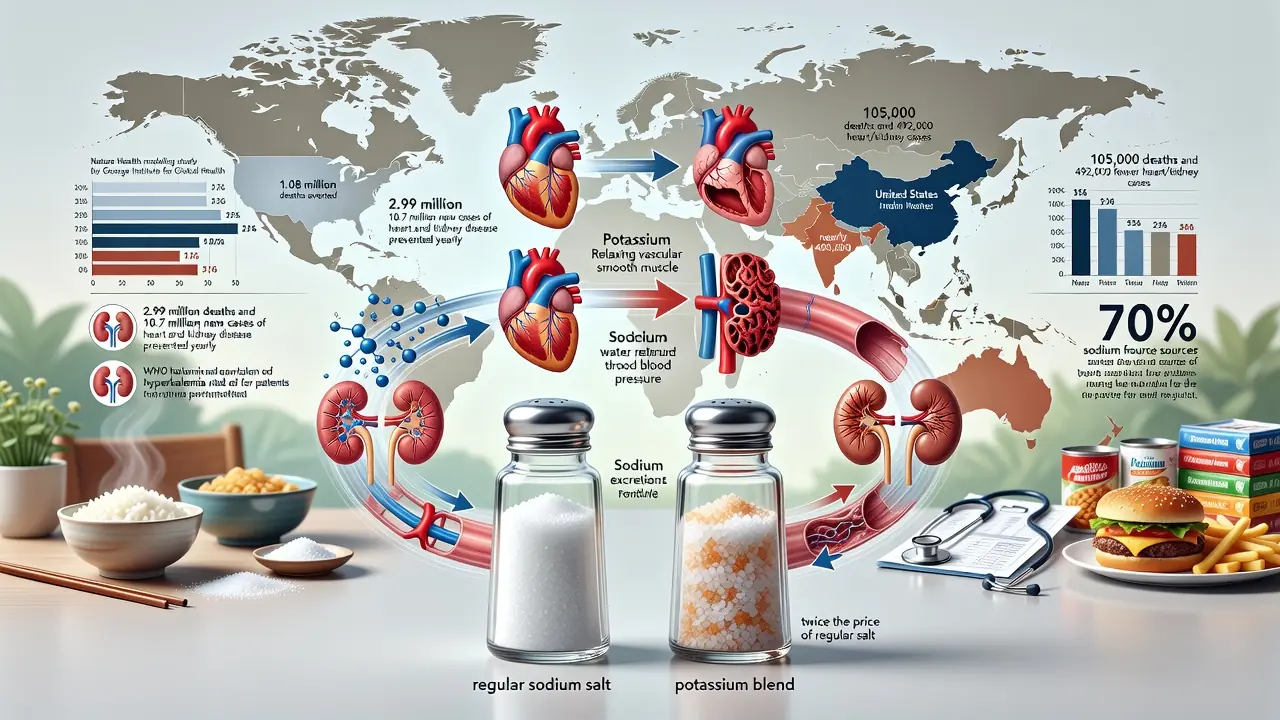
A modeling study in Nature Health estimates that potassium-enriched salt substitutes could prevent about 2.99 million deaths and 10.7 million new cases of heart and kidney disease worldwide each year. The researchers did not test the product in a clinical trial, so the figures rest on simulations that depend on assumptions that may not hold everywhere.
How the substitute works
Potassium-enriched salt replaces part of the sodium in ordinary salt with potassium and can be used in much the same way. Sodium tends to raise blood pressure because the body holds onto water, which increases blood volume and the pressure against artery walls. Potassium helps blood vessels relax and encourages the body to excrete excess sodium, so a substitute that lowers sodium intake while adding potassium may reduce pressure over time.
What the model projected
The George Institute for Global Health in Australia based its estimates on dietary and disease-risk data for 4.6 billion adults in 193 countries. Replacing salt used in home cooking and at the table was projected to avert about 1.85 million deaths a year, while swapping salt in restaurant meals and processed foods was projected to avert about 1.56 million. Switching 80% of adults diagnosed with high blood pressure to the substitute for household use was estimated to prevent roughly 590,000 deaths annually.
The benefits varied by country. China had the largest projected gain under full replacement, at about 1.08 million deaths averted each year. The model estimated nearly 400,000 for India and roughly 105,000 for the United States, where it also projected 492,000 fewer new cases of heart and kidney disease.
Where most sodium comes from
In many Asian and African countries, much of the salt people eat is added during home cooking, which makes household switching the main route to benefit. In Western countries, the study suggests that more than 70% of dietary sodium comes from processed foods and restaurant meals. Those gains would likely depend on food manufacturers and restaurants adopting the substitute, not only on individual shoppers.
Who should check with a doctor first
The substitute is not appropriate for everyone. Excess potassium in the blood, called hyperkalemia, can cause dangerous irregular heart rhythms. The body normally removes extra potassium in urine, but people with advanced kidney disease may not clear it effectively, and some blood pressure medications can also affect potassium levels. The World Health Organization advises against these substitutes for people with kidney problems that impair potassium removal unless a health professional recommends them, so anyone with advanced chronic kidney disease or on potassium-raising medication should consult a doctor before switching.
Cost may also limit uptake. The researchers noted that potassium-enriched salt averages about twice the price of regular salt, and wider use would require cooperation from suppliers, food producers and restaurants.